


Blending Annuals and Perennials for Continuous Summer Bloom
Gardens built on perennials alone can shine brilliantly for a few weeks, then settle into quieter stretches. The solution isn’t to abandon perennials, but to partner them with annuals in a way that keeps the show going from late spring to frost. By layering the strengths of both—perennials for structure and rhythm, annuals for reliable, season-long color—you can create a garden that never feels finished but never feels empty either.
Julie Deane, Dakota County Master Gardener

Understanding the Rhythm of Bloom
Perennials are the backbone of many gardens, but they bloom in waves. Some peak in late spring, others in midsummer, and a final group carries into fall. Even the longest-blooming perennials have natural pauses.
Annuals, on the other hand, are marathon performers. Once planted, they flower continuously until frost, largely indifferent to the seasonal ebb and flow around them. When you design with both in mind, you create a relay: as one plant finishes its moment, another seamlessly takes over.
Color with Intention
A successful mixed planting doesn’t rely on randomness. Start with a defined color palette—whether it’s soft pastels, vibrant contrasts, or a relaxed cottage mix—and repeat those colors throughout the space.
Don’t overlook foliage. Silvery leaves, chartreuse highlights, and deep burgundy tones provide continuity even when flowers ebb, acting as a visual thread that ties the garden.

Designing for a Natural Look
The most effective mixed plantings avoid rigid patterns. Instead of isolating annuals in separate beds, tuck them into open pockets among perennials. This interplanting creates a cohesive, layered look and prevents the garden from feeling segmented.
And always plant with growth in mind. What looks sparse in early spring will fill in quickly. Leave space for air circulation and mature size—your plants will reward you with better health and stronger performance.
Maintaining the Momentum
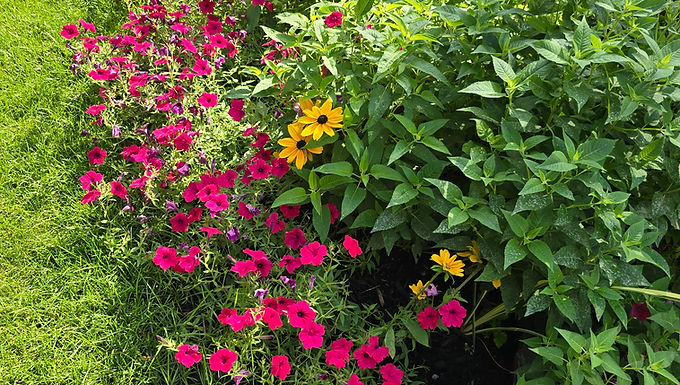
A continuous display does require a bit of attention. Deadheading encourages many annuals—and some perennials—to keep blooming. Or choose plants that don’t require deadheading, like wave petunias and rudbeckia daisies in the pictures. Regular fertilizing supports the heavy flowering demands of annuals, which tend to need more nutrients than their perennial counterparts. Consistent watering, especially in mixed beds, ensures neither group is stressed during hot weather.
By midseason, don’t hesitate to edit. Remove plants that are past their prime and replace them with fresh annuals. This simple refresh can extend the garden’s vibrancy well into fall.

Stretching Your Budget
A beautiful garden doesn’t have to be an expensive one. Invest in high-quality, reliable perennials—they’ll form the backbone of your design for years to come.
Annuals, meanwhile, can often be grown from seed at a fraction of the cost, offering abundant color for minimal investment. Some will even self-seed, returning unexpectedly in future seasons and adding to the garden’s evolving character.
Dividing established perennials is another easy way to expand your planting over time, filling more space without additional cost.

Designing for Continuity
A garden designed for continuous color isn’t about achieving a single perfect moment. It’s about creating a sequence—one that unfolds gradually, shifts with the season, and remains engaging from beginning to end.
When annuals and perennials are thoughtfully combined, the garden becomes less about peaks and pauses, and more about flow. And that’s where the real beauty lies—not in perfection, but in continuity.