


Two-Lined Chestnut Borer and Their Impact on Stressed Oak Trees
Janelle Rietz-Kamenar, Dakota County Master Gardener
Look up, up, and see that Minnesota’s mighty oaks need your help to keep them healthy and strong especially in urban and suburban areas. Many of us gardeners have heard about oak wilt. But we should also be concerned about the Two-Lined Chestnut Borer, an insect that particularly attacks stressed, weakened, or injured oaks causing a slow, steady death after a few years. Why should we care? Oak trees represent 10% of Minnesota’s forests and they have an extremely positive impact on the natural food chain and climate. So, let’s look up and keep an eye open for the two-lined chestnut borer before it’s too late. Click here to learn more.

During the drought years of 2021-2023, many of us watered our lawns, gardens, and small trees but did you think to water those massive oak trees that have been around for decades? Maybe not; we may not think about watering established trees. Two-lined chestnut borers are a secondary pest, meaning they spare healthy trees and invade on stressed trees. Because of this drought and other environmental factors, the two-lined chestnut borer has now become commonplace in the Minnesota’s forest and urban areas.
What do they look like?
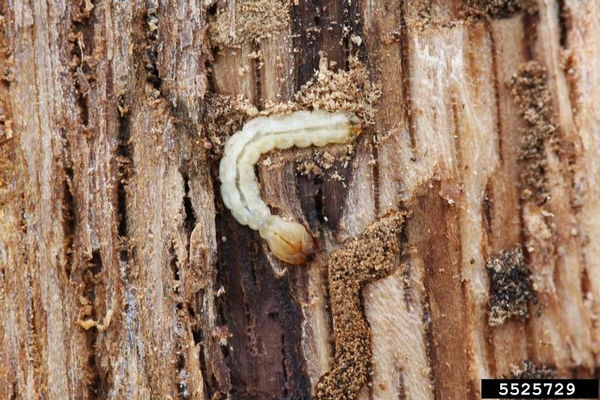
The two-lined chestnut borer is a native, metallic wood borer. It is bluish-black and has two yellow vertical stripes down its back. It’s about 1/5 to 3/8 inches in length. In late May, the beetle emerges from trees and continues to be active until early July. After mating, eggs are placed into bark crevices and hatch within 1 to 2 weeks. The larvae have a legless body that is pale, slender and segmented with darkened mouthparts and a couple of spine-like projections on their end.

How do you know if you have them in your oak tree?
Unfortunately, often times you won’t see their signs and symptoms until it is too late as it will be too high up to get to.
Tops of the tree canopy show die back; in other words, dead branches and small discolored foliage, most noticeable in late July. Eventually the dieback will continue into main branches and tree trunk.
In late May to early July, the beetles emerge from the bark in a small D-shape hole.
If you remove the bark of a dead branch, you may see sawdust S-shaped galleries.
What can we do to help the tree survive?
If the dieback is less than 40% to 50% of the canopy, you can treat it with an insecticide. It is best to contact an arborist as they have more options available such as granules, liquid drench, and tree injections.
Prevention is the best method to save your oak trees. You can do the following:
Add organic mulch around the oak tree canopy floor but don’t put too much mulch within a foot of the tree. Mulch lowers soil temperature and decreases the rate of moisture evaporation. Plants around a tree are fine as long as there is air circulation around the trunk.
Ensure your oaks are well-watered.
Don’t fertilize stressed trees as it will increase the need for additional water and can cause additional injury.
When you plant an oak tree, beware of root girdling (roots circling the tree).
Avoid soil compaction in planting sites and don’t injure tree roots if planting around a tree. Remember tree roots can extend well beyond the canopy floor.
Most pests spread through movement of deadwood. Keep infested wood away from healthy trees.

We love our oak trees in Minnesota. Let’s do everything we can to help them survive.
Sources
https://www.dnr.state.mn.us/treecare/forest_health/oak_decline/index.html
https://trees.umn.edu/sites/trees.umn.edu/files/2021-10/TLCB%20FAQ%20Sheet.pdf
https://extension.umn.edu/tree-and-shrub-insects/metallic-wood-boring-beetles
https://hort.extension.wisc.edu/articles/two-lined-chestnut-borer/
https://files.dnr.state.mn.us/forestry/um/forest-resources-report-2020.pdf
https://dnr.wisconsin.gov/topic/foresthealth/oakwilt