


Don’t Overlook These Early Spring Native Perennials
Julie Harris, Dakota County Master Gardener
When we think of early spring plants in Minnesota, we generally envision bulb plants, such as tulips, daffodils, crocus, hyacinths or allium. But don’t overlook the many beautiful native wildflowers that also bloom in early spring. This article will feature six of these plants. They may deserve a place in your garden or look for them as you stroll through local parks or public gardens.

When we think of early spring plants in Minnesota, we generally envision bulb plants, such as tulips, daffodils, crocus, hyacinths or allium. But don’t overlook the many beautiful native wildflowers that also bloom in early spring. This article will feature six of these plants. They may deserve a place in your garden or look for them as you stroll through local parks or public gardens.
Snow Trillium (Trillium nivale)

Snow Trillium, a Minnesota native, is one of the first wildflowers to bloom in the spring, often appearing while snow is still on the ground. It has delicate white three-part petals about an inch across. The plant is only about 4 inches tall. Snow Trillium grows best in well drained soil and light shade.
Pasque Flower (Anemone patens)

Pasque Flower is commonly found in prairies or along hiking trails. Often one of the first perennials to bloom, it has 1 ½ inch, soft, lavender to white petals and fuzzy stems. The leaves form a mound 10-12 inches tall. Pasque Flower grows in well-drained soil and full sun. The plant remains attractive throughout the summer. All parts of the plant are toxic if ingested but still it has been used medicinally.
Bloodroot (Sanguinaria canadensis)

“Who does not know the bloodroots – babes in the wood – each closely wrapped in the swaddling blanket of a quaintly fashioned grayish-green leaf?” Eloise Butler, 1911. Bloodroot blooms in March and April and dies back in early summer. It has white petals around golden centers and stands 3 - 8 inches tall. There are 6 – 12 petals which reach a total width of 1 – 2 1/3 inches. Its odd name comes from the red sap in its roots and stems. Bloodroot is found in woodlands with moist to dry soil and spreads from rhizomes. Bloodroot needs sunlight before the tree canopy leafs out but then requires shade. All parts of the plant are poisonous in large quantities but it has an extensive history of medicinal use.
Skunk Cabbage (Symplocarpus foetidus)
Skunk Cabbage emerges early in the season, generating its own heat to melt the snow surrounding it. It isn’t a particularly showy plant and does emit an unpleasant scent when crushed but its reddish-purple flowers are an important supporter of early-season pollinators. The heat that it generates helps to attract pollinators. The plant will grow 2 – 3 feet in height with the curled-cabbage-like-leaves appearing after the flower emerges. It can be found in bogs and stream edges.
Hepatica (Hepatica nobilis)
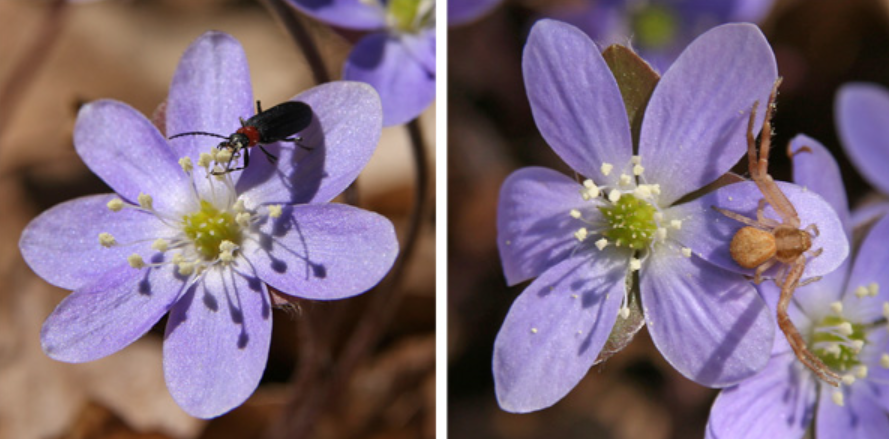
Hepatica, is a lovely early spring perennial with star-shaped flowers in shades of blue, purple and white. The flowers are ½ - 1 inch wide and the plant grows about 12” high. The leaves are evergreen, turning to a purple color in the fall. It is often found in wooded areas alongside Bloodroot. Hepatica is in the buttercup family and goes by the common name “liverleaf” or “liverwort.” The common name comes from the leaves’ resemblance to the human liver. The leaves can be poisonous if ingested and do not appear to have any medicinal value. Many pollinators are attracted to Hepatica during their month-long blooming period.
Dutchman’s Breeches (Dicentra cucullaria)

Dutchman’s Breeches is named for its white, pant-shaped flowers that dangle upside down over dainty leaves. They bloom in March and April and are a favorite of early-season pollinators. The plant grows 4 – 12 inches tall. The flowers have pale red to yellowish stalks, white with yellow or pink-tinged centers about ¾ inches long. The yellow-green or grayish-green leaves have a sharp point and die back in mid-summer. Dutchman’s Breeches prefer dappled sunlight in rich soils under a tall tree canopy. The plant may be harmful if ingested and can cause dermatitis in sensitive people. However, parts of the plant have been used to treat skin diseases.
If you do not have these lovely early perennials in your yard, you can find many of them in parks and nature areas around the twin cities. Of course, the Eloise Butler Wildflower Garden in Hennepin County has been host to nearly all of these wildflowers for decades. So, look forward to taking a walk in nature within the next few weeks and look for these native beauties.
Reference:
https://mplsparksfoundation.org/early-spring-blooms-7-plants-to-spot-in-minneapolis-parks/
https://friendsofeloisebutler.org/pages/seasonal/mcearlyspring.html
Photo Credit: G.D. Bebeau; www.friendsofeloisebutler.org (1,2,3,4,6) University of Wisconsin Extension (5)